Amsterdam, Eindhoven, Helmond, Groningen, Rotterdam, The Hague, Ultrecht in the Netherlands
Friday, 5 August 2022
Climate-neutrality by 2030 for Gozo
Amsterdam, Eindhoven, Helmond, Groningen, Rotterdam, The Hague, Ultrecht in the Netherlands
Friday, 10 June 2022
Ecotourism and Responisble Travel
In plain words, Ecotourism is a form of travelling that is sustainable and organised with respect to the surrounding environment and the well-being of the local people. Its purpose is to benefit the economic development of a local community and to foster cultural and human rights. In its essence, Ecotourism stands for a travel experience to a destination that is relatively untouched by humans, to focus on educating the traveller with an eye to ecological conservation.
Today, Ecotourism is a term used to describe socially responsible travelling. The popularity of Ecotourism is fueled by greater public awareness of the negative impacts of tourism be it on the destination or natural environment.
As the entire world is focusing to find alternative sustainable means of energy, transporation, and production; so is the sector of tourism moving towards a new 'green' era. More and more tourism destinations and operators are adopting ecological best practices and many tourists are becoming aware of their ecological impact when they visit natural areas.
We've outlined a few ways that you can reduce your carbon footprint while travelling and make your holiday greener. Green travel is about making smart choices and keeping the environment in mind at each twist and turn. First and foremost, plan in advance. The more time you spend planning and researching options the better the chances of enjoying a smooth, sustainable empowering holiday.
Travelling by plane
Air travel is not sustainable, and even though we can never tell what type of scientific and technological breakthroughs there will be in the future, sustainable air travel is not projected to become eco-friendly anywhere in the forseeable future. The only way that we can make travelling by plane more responsibly, is to choose short routes. Exotic, faraway loctions are a thrill however choosing a destination closer to home is much kinder to the planet. Alternatively, you can compensate for your flight's CO2 on an online carbon offsetting site or app.
Travelling by boat
Cruise liners are not eco-friendly at all. They dump toxic waste into the ocean, run on giant diesel engines that fill the planet with carbon dioxide and kill marine wildlife. However, today many cruise line companies are incorporating green technologies into newly built ships, inclusive of solar panels, a cooking oil conversion system and energy-efficient appliances. Many liners are also removing single use plastic, recycle more effectively and donate unwanted furniture and linen to charities instead of being sent to landfills. The cruise liner industry is getting greener. Choose one of the cruise liner companies who are implementing sustainable practices. For instance, Carnival ships plug into electrical power when docked, eliminating noise and air pollution while idle; while Costa launched a new ship that runs on LNG, utilizing the world's cleanest-known fossil fuel.
Trains are the ultimate environmentally-friendly mode of tranport. They allow you to travel long distances in a relatively short amount of time. They can carry large volumes of passengers which makes them far more sustainable than other modes of transport. Travelling by train is easy, comfortable, picturesque, with fewer chances of delays; you can read, sleep and eat or do whatever you want!
Waste
Food and packaging waste accounts for as much as half of what is thrown away in a day, especially when you are far from home. There are some easy ways for you to reduce your packaging whilst travelling; such as: keep reusable bags and containers and don't be shy to say no to more bags when shopping; choose zero-waste toiletries; go paperless.
Fairtrade
Sustainable tourism is kind tourism. The concept of fairtrade ensures that preference is given to locally sourced products and the workers get fair compensation in good conditions. In tourism, fairtrade ensures that the benefits and income are rightly distributed amongst the local people who are involved in that product or service. How to support fair trade as a traveller? Be mindful and make conscious shopping choices by avoiding mass-produced products and instead favour local artisans and certified Fairtrade stores.
An eco-friendly accommodation refers to a place that is built or operated in such a way as to minimize both the carbon footprint of the business operation as well as the carbon footprint of those who work and stay there. You might have heard of Eco Hotels or Eco Resorts. But what does that really mean? It means that the administration is taking measures that may include reducing energy and water consumption, aiming for zero waste generation, handle the waste in the proper way, and using environmentally-sound products.
Live the local experience
Homestays, local guides and programs that give back to the community are an excellent way to enjoy your destination with purpose. Check out ecobnb for a network of sustainable accommodation, where you can see in real time the number of CO2 avoided every day, the number of trees and liters of water saved every day.
Need inspiration of where to go this summer? Check out these top 10 eco-friendly cities and countries in the world!
Top 10 most eco-friendly cities in the world
* Copenhagen, Denmark
* Amsterdam, Netherlands
* Stockholm, Sweden
* Berlin, Germany
* Portland, Oregon
* San Francisco, California
* Cape Town, South Africa
* Helsinki, Finland
* Vancouver, Canada
* Reykjavik, Iceland
Top 10 most eco-friendly countries in the world
* Denmark
* Luxembourg
* Switzerland
* United Kingdom
* France
* Austria
* Finland
* Sweden
* Norway
* Germany
Friday, 14 January 2022
Why happiness is good for the planet
What makes us happy?
Money? Stuff? Success? Relationships? Family?
An increasing foundation of scientific research shows a significant linkage between personal well being and environmental behaviours. This is not a coincidence; it is a profound truth of crucial importance in the quest to create sustainable socities. It proves beyond a doubt that sustainability has nothing to do with sacrifice and everything to do with creating a better world for ourselves and our children.
If you think about it from an anthropological point of view, it is not surprising. Happiness is an evolved trait that optimizes our behaviour for successful living and therefore survival. No surprise then that behaviour that harm ourselves and the planet are increasingly lowering our well-being and vice-versa.
According to EcoHustler, below are 5 of the top reasons why people are happier.
1. Living a more local life
Modern transportation brought a new era of individual freedom; however society has restructed it around a range of social problems; pollution, congestion, obesity, stress, respiratory problems and traffic accidents. When one's life revolves the same local area, it results in fewer resources used, less pollution, more time for leisure or family. Other well being benefits include a resurgence of active communities, greater closeness of people to the natural environment, improved safety and improved environmental quality of communities.
2. More vibrant healthy communities
Walking or cycling to work, school and shopping increases your regular contact with people in your community. This is fundamental to improving wellbeing because human relationships are consistently found to be the most important correlation with human happiness.
3. Connection to the natural world
Green people have an appreciation of their place within the great natural scheme of things and tend to feel closeness to other organisms and to wild spaces. This can be a source of inspiration and enrichment thoughout life. Caring for nature focuses ones attention out of oneself which helps to void the angst and self obsession that is a by-product of our individualistic consumer times.
4. Less materliastic
People who are less interested in material things have a tendency to consume less and therefore use fewer resources and have a lower ecological footprint. These people are also usually happier than those who hold on to stuff and constantly crave for more. Once we have all that we need to survive (food, water, shelter), additional material things have less and less impact on our wellbeing. Many surveys have discovered that people were happier after spending money on experiences, rather than physical things. Socializing, sport, creative arts, performance, music, cooking, gardening, hiking - all are popular pursuits that increase happiness and reduce ecological footprints.
5. Personal development
When we look at the 'Hierarchy of Needs' (as described by Abraham Maslow), we see that the lowest levels are occupied by physiological needs. As these are met, higher levels of needs emerge, these are termed growth needs and are associated with psychological needs. While our lowest needs must be met, our higher needs are continually shaping our behaviour. Marslow, who studied people such as Einstein and Roosevelt, declared that self-actualized people embrace facts and realities rather than denying or avoiding them; they are interested in solving problems, and have a system of morality that is fully internalised and independent of external authority. Personal development allows people to turn their attention and create energies to find solutions to big challenges, such as our collapsing biosphere.
Happiness vs GDP
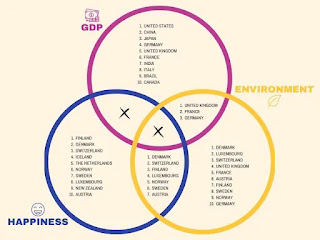
Some argue that, GDP is crucial for governments to make investments that improve well-being for their citizens and protect the environment. But is it really so? The Venn diagram below compares the 10 highest-ranked countries in three categories; wealth, happiness and environment.
The central takeaway from this diagram is the significant overlap between happiness and environmnt. Seven countries appear on both lists: Denmark, Switzerland, Finland, Luxembourg, Norway, Sweden and Austria. Out of the tp environmental performance, the only countries that failed to earn a spot on the happiness list are the same ones that overlap with GDP (UK, France and Germany).
Click here to see Happiest countries in the World 2021 list
At a bare minimum, we can conclude GDP is not the most important factor in determining environmental sustainability and th well-being of people. That's because GDP only measures how much money a country has, not how it chooses to spend it!
For this reason, GDP can b counterproductive to happiness and the environment. But it doesn't have to be. Governments need to start seeing GDP as a limited measurement that factors into national progress, but is ultimately inferior to the measurement of happiness and environmental sustainability. Such a fundamental shift would allow lawmakers to prioritize the issues that save the planet while improving the lives of everyone on it.
Credit: earthday.org
If you want to be happy for an hour, get drunk.
If you want to be happy for three days, get married.
If you want to be happy forever, make a garden.
Chinese proverb
Wednesday, 16 December 2020
The Future of Retail
It is not easy to write an end-of-year post for 2020! A strange year that negatively influenced so many people across the world. My heart goes out to all the hard-working entrepreneurs worldwide who were forced to pause, or even close their business. But, as I wrote at the beginning of the lockdown, 'every obstacle carries with it the seed of an equal, or even greater, benefit' (words of Napoleon Hill).
While the Eco Market events had to be canceled and all our work came to a standstill, we decided to take our own advice and find a new solution. And we are very excited to finally able to announce the launch of our new project.
This concept was conceived years ago as a long-term objective, something to be achieved in the distant future. However, when Covid hit, we immediately realized that it was time to bring it to life. 2020 changed the face and nature of the consumer's purchasing behavior as online stores, together with cash-less transactions, became necessary for their safety and convenience. Creating an online business suddenly appeared to be the only logical thing to do. The future of retail is clearly online.
Coral is a multi-vendor online marketplace that features a myriad of products from many different businesses and artisans in Malta. What makes this online store really unique is the fact that all the products featured on it, possess specific common aspects – they are all good for the body and good for the planet.
Coral is the ideal shopping platform for the health-conscious and eco-conscious consumer. Everything is marked according to our sustainability criteria, which ensures that each product has the right benefits. For instance, if you are vegan, you can search according to this criterion, and your search results will only show you vegan-approved products. There are 25 different sustainability criteria, which allows the buyer to discover and choose products according to their ethics, beliefs, and preferences. (click to enlarge)
A little background story on Coral
Coral is probably one of the most visually beautiful elements of underwater life. Sadly, corals around the world are dying, in most of the cases through what is called bleaching. This crisis is a result of elevated sea temperatures which ‘bleaches’ the coral; it loses its algae and becomes white. We already lost more than half of the world’s coral reefs to bleaching. Scientists predict that by 2050, all coral reefs will be in danger, if global warming is not tackled seriously.
Recently, I watched the documentary 'Chasing Coral' on Netflix. If you have not yet watched it, I highly recommend you do. We are in awe of this magnificent organism and its qualities. Did you know that Coral properties are used for the treatment of conditions such as arthritis and cancer? Did you know that Malta is home to the deepest and most precious Coral in the world? You can tell how it influenced us :)
The platform contains several other innovative features. First of all, it gives the buyer the convenience of finding everything in the same place. The site is extremely user-friendly, dynamic, and intuitive, with a myriad of categories including Fashion & Accessories, Baby & Kids, Health & Beauty, Home & Office, Travel & Outdoors, and Food & Beverage.
Buyers can create their own accounts, leave their own reviews on their purchases, and create wish-lists, whilst enjoying 100% buyer protection and safety.
We invite you to discover Coral for yourself by going to coral.shopping
Interested in becoming a vendor on Coral?
You can apply from HERE
Tuesday, 3 November 2020
Creating positive changes at Christmas time
If there was ever a time that could push us towards positive change, then this is definitely it! This year we all had our share of fear and faith, reflection and prudence. Besides the chaos and the inconveniences, we have re-discovered extraordinary benefits of slowing down the pace of our lives. Covid taught us many valuable lessons, the most important of which is a necessity to live on a healthy planet and maintain a healthy eco-system. Climate change is real. Biodiversity loss is real. Air and sea pollution are real. All these contribute to unsustainability. As citizens of planet Earth, we are all responsible, and we must therefore become accountable for our own actions and habits. Christmas and New Year are traditionaly the most ideal times to bring about change, and our next big lesson to learn is how to live sustainably.
What is sustainability?
To be sustainable, means to be able to maintain a balanced level of give and take. Right now, the planet is in an unsustainable state, for we are taking more than we are giving back - and we are taking quicker than the planet can regenerate by itself. One of the principal problems of unsustainability is consumption. Since the industrial revolution and the invention of plastic a hundred or so years ago, we have been consuming carelessly, impulsively, and negligently. We buy without thinking and we buy things we don't need, and in particular during Christmas time, we are relenetlessly driven into an over-consumption race with the excuse of gifting and celebrating.
Becoming a conscious consumer means that you put thought and care before purchasing anything. Asking yourself questions such as: Where was this made? How did it arrive here? Who made it? Who or what suffered so that this prouct could be created? Celebrating a 'Green' Crhsitams is possible when you choose eco-sustainable products. It means that the products were sourced, manufactured, produced, packaged and transported with respect to the environment. An eco-friendly product is a product that was made with sustainability as a priority guideline.
What is good for the planet is also good for the people
This is a pleasant consequence that not everybody knows about. Eco-sustainable products are not only good for the environment, but also good for people. For instance, sustainable food and beverage products would not contain any dangerous chemicals or pesticides; and Eco-friendly body products would not contain anyd harmful substances. Therefore, if you care about what you put in and on your body, and want to live a healthy lifestyle, choosing sustainable products is the way forward.
Choosing eco-sustainable options
So, let's end this strange and mysterious year on a good note! Let us start taking responsibility for our actions and choose ethical and sustainable gifts for our loved ones taking inspiration from Malta's Top Eco-friendly Gift Ideas, a list created by Eco Market Malta. The list contains a beautiful collection of gift ideas from local green startups, artisans and SMEs. Shopping local is a huge factor for sustainability as it reduces the product's carbon footprint. Choosing to buy products from this list will also eliminate the risk of buying something that only pretends to be eco-friendly as our sellers are well curated.
Malta's Top Eco-friendly Gift Ideas features 30 perfect gifts for your friends and family members. For instance, the Zero Waste Starter Kit is an elegant box ready to be gifted to someone who wants to reduce the use of plastic; while the Eco Gardener Kit is your ideal gift for your green-finger friend.
There are also several gift options for sustainable home appliances, jewellery, clothing, beauty, decor, wellness, children's toys, gifts for the new mum, and unique original ideas such as 'adopt a dolphin'.
Whether you are buying for an eco-conscious person, or someone who is not yet environmentally-aware, this list offers quality and well-priced gift ideas for everyone. As consumers we can make a conscious choice to bring positive change in our lives, and since actions speak louder than words, your eco gift will also be a message inviting others to make their own positive impact. It is no secret that a meaningful and thoughtful gift is more appreciated than any high-priced item money can buy. This year, let's choose to shop sustainably and responsibly, avoid waste, be kind to the planet and enjoy a simple and 'green' Christmas.
Wednesday, 20 May 2020
A virtual event for body-mind-soul-planet goodness
We chose 'Health and Wellness' as our first theme, where we will cover a myriad of branches that belong to the Health and Wellness sector including mental health, fitness, healthy food, and so on.
Through these online events, we will introduce you to a number of hand-picked industry professionals that run sustainable ethical businesses.
Learn more and support local responsible businesses and entreupreneurs who not only offer quality products and services, but they do so with conscious respect to the environment.
You can read more about each speaker by clicking on their name.
Saturday 30 May
Roberta Manucci - Foot and Hand Reflexology Therapist
Petra Spiteri - Mindfullness Trainer
Giancarlo Vella - Holistic Massage and Asthanga Vinyasa Yoga
Vanny Vella - Spiritual and Life Coach and Reiki Master
Alex Cachia - Permaculture Teacher and provider of Self-Development and Wellness workshops
Cristina Cargnelli - Founder of a local Aristan Bakery shop specialising in vegan / vegetarian savouries and sweet items
Sunday 31 May
Amanda Savona - Law of Attraction Life Coach
Alessandra Piva - Holistic Therapist specialising in Facial Reflexologist and Dien Chan
Janet Falzon - Psychologist and Mindfulness, Meditation and Self-Compassion Teacher
Eloise Debono - Owner of a vegan, non-GMO, cold-pressed seed juice Business
Rebecca Borg - Professional Massage Therapist
Yanica Fenech - Yoga Instructor specialising in Body Alignment, Breathing Techniques (pranayama) and Awareness.
-
When we talk about climate activists, the name Greta Thunberg immediately comes to mind. While the young Swedish activist has made significa...
-
Are you an entreupreneur looking for a great new start-up? In this article we are writing down the trendiest ideas tinted green. It is evid...
-
On 28th April 2022, the EU Commission announced the 100 cities selected for a mission in becoming a carbon-neutral and smart city by 2030. ...