Showing posts with label sustainability. Show all posts

Friday, 10 June 2022

Ecotourism and Responisble Travel

In plain words, Ecotourism is a form of travelling that is sustainable and organised with respect to the surrounding environment and the well-being of the local people. Its purpose is to benefit the economic development of a local community and to foster cultural and human rights. In its essence, Ecotourism stands for a travel experience to a destination that is relatively untouched by humans, to focus on educating the traveller with an eye to ecological conservation. 


Today, Ecotourism is a term used to describe socially responsible travelling. The popularity of Ecotourism is fueled by greater public awareness of the negative impacts of tourism be it on the destination or natural environment. 

As the entire world is focusing to find alternative sustainable means of energy, transporation, and production; so is the sector of tourism moving towards a new 'green' era. More and more tourism destinations and operators are adopting ecological best practices and many tourists are becoming aware of their ecological impact when they visit natural areas. 


We've outlined a few ways that you can reduce your carbon footprint while travelling and make your holiday greener. Green travel is about making smart choices and keeping the environment in mind at each twist and turn. First and foremost, plan in advance. The more time you spend planning and researching options the better the chances of enjoying a smooth, sustainable empowering holiday. 


Travelling by plane

Air travel is not sustainable, and even though we can never tell what type of scientific and technological breakthroughs there will be in the future, sustainable air travel is not projected to become eco-friendly anywhere in the forseeable future. The only way that we can make travelling by plane more responsibly, is to choose short routes. Exotic, faraway loctions are a thrill however choosing a destination closer to home is much kinder to the planet. Alternatively, you can compensate for your flight's CO2 on an online carbon offsetting site or app.

Travelling by boat

Cruise liners are not eco-friendly at all. They dump toxic waste into the ocean, run on giant diesel engines that fill the planet with carbon dioxide and kill marine wildlife. However, today many cruise line companies are incorporating green technologies into newly built ships, inclusive of solar panels, a cooking oil conversion system and energy-efficient appliances. Many liners are also removing single use plastic, recycle more effectively and donate unwanted furniture and linen to charities instead of being sent to landfills. The cruise liner industry is getting greener. Choose one of the cruise liner companies who are implementing sustainable practices. For instance, Carnival ships plug into electrical power when docked, eliminating noise and air pollution while idle; while Costa launched a new ship that runs on LNG, utilizing the world's cleanest-known fossil fuel. 


Travelling by train

Trains are the ultimate environmentally-friendly mode of tranport. They allow you to travel long distances in a relatively short amount of time. They can carry large volumes of passengers which makes them far more sustainable than other modes of transport. Travelling by train is easy, comfortable, picturesque, with fewer chances of delays; you can read, sleep and eat or do whatever you want!

Waste

Food and packaging waste accounts for as much as half of what is thrown away in a day, especially when you are far from home. There are some easy ways for you to reduce your packaging whilst travelling; such as: keep reusable bags and containers and don't be shy to say no to more bags when shopping; choose zero-waste toiletries; go paperless. 


Fairtrade

Sustainable tourism is kind tourism. The concept of fairtrade ensures that preference is given to locally sourced products and the workers get fair compensation in good conditions. In tourism, fairtrade ensures that the benefits and income are rightly distributed amongst the local people who are involved in that product or service. How to support fair trade as a traveller? Be mindful and make conscious shopping choices by avoiding mass-produced products and instead favour local artisans and certified Fairtrade stores. 


Accommodation

An eco-friendly accommodation refers to a place that is built or operated in such a way as to minimize both the carbon footprint of the business operation as well as the carbon footprint of those who work and stay there. You might have heard of Eco Hotels or Eco Resorts. But what does that really mean? It means that the administration is taking measures that may include reducing energy and water consumption, aiming for zero waste generation, handle the waste in the proper way, and using environmentally-sound products. 


Live the local experience

Homestays, local guides and programs that give back to the community are an excellent way to enjoy your destination with purpose. Check out ecobnb for a network of sustainable accommodation, where you can see in real time the number of CO2 avoided every day, the number of trees and liters of water saved every day.


Need inspiration of where to go this summer? Check out these top 10 eco-friendly cities and countries in the world!


Top 10 most eco-friendly cities in the world

* Copenhagen, Denmark

* Amsterdam, Netherlands

* Stockholm, Sweden

* Berlin, Germany

* Portland, Oregon 

* San Francisco, California

* Cape Town, South Africa

* Helsinki, Finland

* Vancouver, Canada 

* Reykjavik, Iceland


Top 10 most eco-friendly countries in the world

* Denmark 

* Luxembourg

* Switzerland

* United Kingdom

* France

* Austria

* Finland

* Sweden

* Norway

* Germany                                                                          


Thursday, 3 March 2022

Earth Hour ideas for businesses

Every year since 2007, at 8.30pm on the last Saturday of March, people in over 190 countries unite to raise awareness and inspire action for climate change and bio-diversity loss - two urgent threats to our home and our standard of living.  Earth Hour is more than just a yearly occasion, it is a movement fighting for a better, healthier and more sustainable future. 


Today Earth Hour has become a catalyst for positive enivronmental impact, sparking global conversations on protecting nature and tackling the climate crisis. Several businesses around the globe are enthusiastically embracing Earth Hour - from turning off lights at headquarters, flipping the switch on iconic landmarks, and spreading the word amongst employees and customers to participate. This single act is provoking discussion and building momentum towards a renewable future. 


Earth Hour is a great opportunity for your business to demonstrate your commitment to the environment, showcase your existing environmental work and engage with your communities. Here are some tips for how your business can support Earth Hour 2022 - Saturday 26th March.


Switch off the lights

Switch off non-essential lights in your buildings, facilities and signage during Earth Hour from 8.30pm to 9.30pm. For offices that are closed over the weekends, ensure that all lights are turned off on Friday evening.


Nominate an 'Earth Hour' champion

Elect an Earth Hour champions for your business. Their job will be to introduce more sustainable measures to the workplace and ensure the lights are out and appliances are switched off and ideally unplugged, not only for the hour but at the end of each working day. Large companies may want to look into the concept of creating a Green Team.


Incentivise your employees

In the fight against climate change, no action is too small. Ensure recycling bins are accessible all over the workplace. Avoid single-use plastic in the office, like one-time coffee pods; opt instead for fair-trade coffee. Choose zero-waste items for your kitchenette and toileteries. Incentivise car-pooling, public transportation and biking to work. 


Spread the world

Spread the word about Earth Hour in your office, building, and on your digital networks. You can add a banner on your online pages and websites, change your email signature or make a temporary tweak/addition to your logo or branding. Create buzz at the office, ask employees to wear a green T-Shirt on the day or print some yourself with your brand logo and the Earth Hour symbol. 


Invest in nature

The science is clear. The health of the planet is declining at rates never seen in human history and that is putting our global economy at risk, as well as undermining human health, well-being and progress. Food, energy, and water are critical resource challenges for any company, and offering sustainable alternatives will enhance your business's reputation with features that modern investors and customers are seeking for in a company. 


Redefine your purpose

A clear company purpose that drives business and sustainability can help customers make informed choices and live more sustainably. Take the opportunity to align your company's policies and values with sustainability, and embrace forward-thinking eco-sensible solutions. 


Go beyond the hour

The purpose of Earth Hour is to instill sustainable habits. This means making a commitment to a continual change throughout the year that reduces your impact on the environment. Organising environmental stewardship activities for your employees is an excellent way to inspire climate action amongst the workforce and highlighting your environmental contribution to customers and shareholders. Visit this LINK to read about Eco Market Malta's CSR activities.  


Use the SDGs 

The UN 17 Sustainable Development Goals are a blueprint for business leadership. Get familiar with them, print a copy and stick it on your cork board or use the global goals as your desktop picture. They will serve as a guide for a better and more sustainable future for all. 


Last but not least, download the official Earth Hour 2022 Business Pack which includes a handbook for employee engagement.


Thursday, 17 February 2022

Top 5 Sustainability trends for islands in 2022

The concept of sustainability has garnered an increasing amount of focus over the past few years, especially in light of the continuing pandemic. Stakeholders in the environmental arena, including governments, members of the public, the private sector, the civil society and academia, are all increasingly recognizing the need to adopt sustainable practices as a way to build resilience in island communities. Here are the top 5 trends which will help to overcome the climatic, environmental, social and economic challenges that islands face, and which will help to nurture a sense of collective purpose.


1. Sustainable Finance


According to sustainablefitch.com, the financial world is sitting up and taking notice of the need to focus on creating innovative and relevant financial instruments to more adequately address issues related to Economic and Social Governance (ESG). 

The term 'Impact Investment' refers to 4 main elements;


* Intentionality: An investor's intention to have a positive social or environemtnal impact through investments.

* Return Expectations: Impact investments are expected to generate a financial return on capital or, at minimum, a return on capital.

* Asset Classes - Impact investments target financial returns that range from below market to risk-adjusted market rate, and can be made across a variety of asset classes, including cash equivalents, fixed income, venture capital and private equity.

* Impact Measurement - A fundamental concept of impact investing is the commitment of the investor to measure and report the social and environmental performance and progress of underlying investments. This has the added benefit of ensuring transparency and accountability while informing the practice of impact investing and building the field. In this regard we recommend reading 'The Clean Money Revolution' by Joel Solomon.


2. Climate Positivity

This refers to a more positive, holistic and regenerative approach to combating climate change, while not diminishing the seriousness of the situation. This positivity will balance the negative and seeks to establish a new framework to not only neutralize carbon emissions, but to positively create environmental benefits.


The main sectors which will need focus are industrial animal agriculture, mobility, green buildings, and affordable clean energy. Indeed, it has been established that renewables increasingly undercut the existing operational costs of utilizing fossil fuels, therefore more economic renewables can provide developed islands a strong business case to power past coal in pursuit of a net-zero economy in 2022 and beyond. 


3. Ocean sustainability

This is a crucial trend of island nations, as the 'Blue Economy' is an emerging economic paradigm that focuses on creating better stewardship of our ocean and blue resources, with the primary goal of keeping global heating within 1.5 degrees C. The ocean plays a major role in the social, economic and cultural identities of island inhabitants, so it is critical that it protected and regenerated. 


Plastic pollution must be addressed as a matter of urgency in 2022, as current estimates indicate that at least 14 million tons of plastic end up in the ocean every year. Plastic debris is now the most abundant type of litter in the ocean, making up 80% off all marine debris found from surface waters to deep-sea sediments. Island countries need to be aware of the plastic's negative impact not only on the marine ecosystem, but also on food, human health, tourism and climate. 


4. Innovation in nature-based solutions

Nature-based solutions are emerging as some of the most sustainable ways for islands to deal with the climate crisis. These solutions have become a trend which focuses on using biodiversity and the natural functions of healthy ecosystems to deal with some of the most pressing challenges caused by climate change, while providing numerous economic and social benefits. 


The term 'Nature-based solutions' refers to the sustainable management and use of natural features and processes to tackle socio-environmental challenges; such as climate change, water security, water pollution, food security, human health, biodiversity loss, and disaster risk management. 

The key to innovate in nature-based solutions is to involve as many stake holders as possible; including the local community, entrepreneurs, students, scientists, NGOs and social enterprises - support them and provide them with the necessary funds and resources to conduct R&D and to start sustainable businesses and eco-tourism solutions. 

5. The Circular Economy


Perhaps one of the most significant trends of 2022 is the evolution of the circular economy. This trend is generally seen to have been rooted in the positive images of nature that emerged during the pandemic, and which prompted an increased awareness on the part of consumers about the healing powers of nature. They became more environmentally optimistic, and determined to protect this optimism by investing in eco-friendy products, as well as praticing recycling. A recent study by the World Economic Forum illustrated that, based on the current consumption patterns, we will soon need three times the amount of natural resources, which means three more planets. 


The emergence of these sustainability trends and their relevance to islands all over the world show us the necessity of pursuing innovative solutions to challenges facing island communities. These trends are an important aspect of building the empowerment and resilience necessary to build a sustainable, strong and vibrant future for all islanders!


Credit: islandinnovation.co


Friday, 14 January 2022

Why happiness is good for the planet

What makes us happy?

Money? Stuff? Success? Relationships? Family? 


An increasing foundation of scientific research shows a significant linkage between personal well being and environmental behaviours. This is not a coincidence; it is a profound truth of crucial importance in the quest to create sustainable socities. It proves beyond a doubt that sustainability has nothing to do with sacrifice and everything to do with creating a better world for ourselves and our children. 


If you think about it from an anthropological point of view, it is not surprising. Happiness is an evolved trait that optimizes our behaviour for successful living and therefore survival. No surprise then that behaviour that harm ourselves and the planet are increasingly lowering our well-being and vice-versa.

According to EcoHustler, below are 5 of the top reasons why people are happier.

1. Living a more local life

Modern transportation brought a new era of individual freedom; however society has restructed it around a range of social problems; pollution, congestion, obesity, stress, respiratory problems and traffic accidents. When one's life revolves the same local area, it results in fewer resources used, less pollution, more time for leisure or family. Other well being benefits include a resurgence of active communities, greater closeness of people to the natural environment, improved safety and improved environmental quality of communities. 


2. More vibrant healthy communities

Walking or cycling to work, school and shopping increases your regular contact with people in your community. This is fundamental to improving wellbeing because human relationships are consistently found to be the most important correlation with human happiness. 


3. Connection to the natural world

Green people have an appreciation of their place within the great natural scheme of things and tend to feel closeness to other organisms and to wild spaces. This can be a source of inspiration and enrichment thoughout life. Caring for nature focuses ones attention out of oneself which helps to void the angst and self obsession that is a by-product of our individualistic consumer times. 


4. Less materliastic

People who are less interested in material things have a tendency to consume less and therefore use fewer resources and have a lower ecological footprint. These people are also usually happier than those who hold on to stuff and constantly crave for more. Once we have all that we need to survive (food, water, shelter), additional material things have less and less impact on our wellbeing. Many surveys have discovered that people were happier after spending money on experiences, rather than physical things. Socializing, sport, creative arts, performance, music, cooking, gardening, hiking - all are popular pursuits that increase happiness and reduce ecological footprints. 


5. Personal development

When we look at the 'Hierarchy of Needs' (as described by Abraham Maslow), we see that the lowest levels are occupied by physiological needs. As these are met, higher levels of needs emerge, these are termed growth needs and are associated with psychological needs. While our lowest needs must be met, our higher needs are continually shaping our behaviour. Marslow, who studied people such as Einstein and Roosevelt, declared that self-actualized people embrace facts and realities rather than denying or avoiding them; they are interested in solving problems, and have a system of morality that is fully internalised and independent of external authority. Personal development allows people to turn their attention and create energies to find solutions to big challenges, such as our collapsing biosphere.


Happiness vs GDP

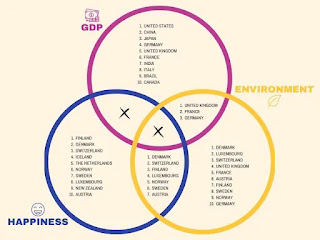
Some argue that, GDP is crucial for governments to make investments that improve well-being for their citizens and protect the environment. But is it really so? The Venn diagram below compares the 10 highest-ranked countries in three categories; wealth, happiness and environment. 


The central takeaway from this diagram is the significant overlap between happiness and environmnt. Seven countries appear on both lists: Denmark, Switzerland, Finland, Luxembourg, Norway, Sweden and Austria. Out of the tp environmental performance, the only countries that failed to earn a spot on the happiness list are the same ones that overlap with GDP (UK, France and Germany).

Click here to see Happiest countries in the World 2021 list

At a bare minimum, we can conclude GDP is not the most important factor in determining environmental sustainability and th well-being of people. That's because GDP only measures how much money a country has, not how it chooses to spend it!

For this reason, GDP can b counterproductive to happiness and the environment. But it doesn't have to be. Governments need to start seeing GDP as a limited measurement that factors into national progress, but is ultimately inferior to the measurement of happiness and environmental sustainability. Such a fundamental shift would allow lawmakers to prioritize the issues that save the planet while improving the lives of everyone on it.

Credit: earthday.org


If you want to be happy for an hour, get drunk.

If you want to be happy for three days, get married.

If you want to be happy forever, make a garden.

Chinese proverb